Local Government Re-organisation 

Information page (updated 12.01.2026)

This page is designed as a reference point providing updates and guidance for town and parish councils and parish meetings in Suffolk in relation to local government re-organisation.  A separate information about "devolution" and the creation of a new Combined Norfolk and Suffolk Mayoral Strategic Authority will be available soon.

What is LGR?

Local government reorganisation, or LGR, is a process where the structure of local councils is changed, often involving the creation of new unitary authorities or combined authorities.

This can mean merging existing councils, redrawing boundaries, or shifting responsibilities. The aim is to create more effective, efficient, and sustainable local government structures, particularly in areas with two-tier systems (county and district councils) or where existing unitary councils are struggling. 

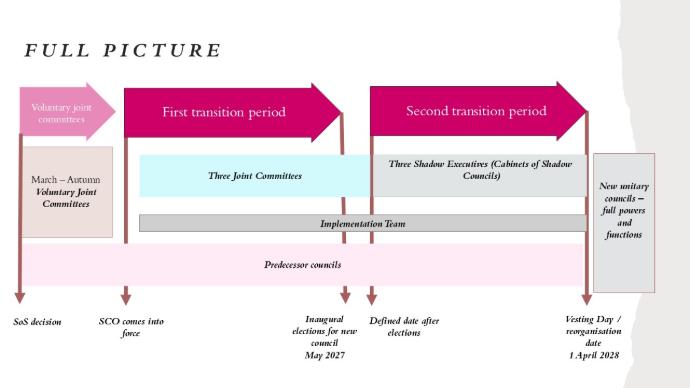
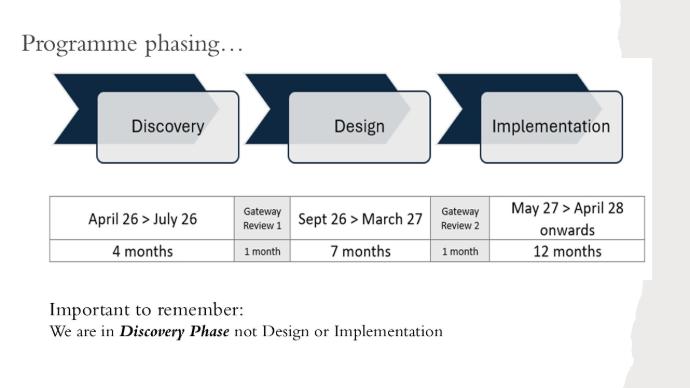
What is the current timeline for changes in Suffolk?

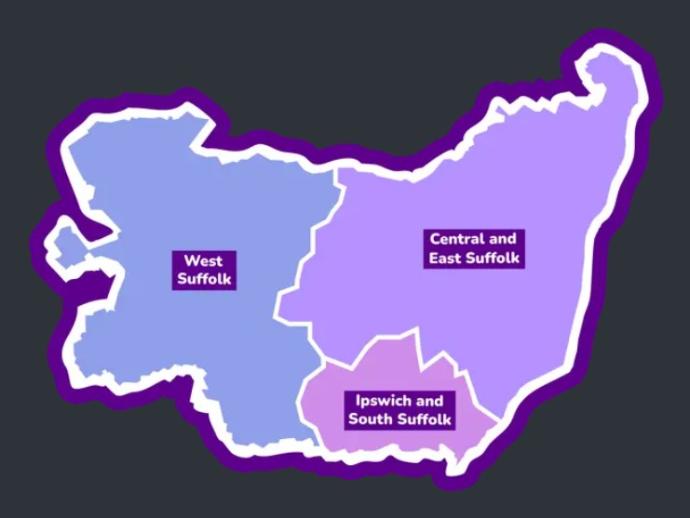
Suffolk is part of the priority programme and detailed business plans in relation to local government re-organisation have been submitted to government by district, borough and county councils.   It is anticipated a final decision will be made towards the end of March 2026 on whether the current two tier system that sits above the town and parish council and parish meetings "grass roots" tier will be replaced by one or three unitary authorities.

What about elections?

Government postponed the 2025 County Council elections and on 18th December 2025, Alison McGovern MP, Secretary for Statement for Local Government and Homelessness wrote to leaders of councils with elections in May 2026 where proposals for re-organisation have been submitted and decisions not yet taken.  The letter invited those councils (which includes Suffolk County Council) to set out their views on the postponement of their local elections and if they considered this could release essential capacity to deliver local government reorganisation in our area and so allow reorganisation to progress effectively.

On 12th January Suffolk County Council held an extraordinary meeting on this topic was debated and was followed by a Cabinet meeting to formally agree whether the leader of the council should submit a response to the Minister's letter.  It was decided that Suffolk County Council will write to Government as requested by Ministers to outline essential capacity issues caused by local government reorganisation.  View the news story here.

Was there consultation on the final proposals submitted to Government?

Yes - Government launched a formal consultation across Suffolk and Norfolk on the detailed business cases submitted.   The deadline closed on 11th January 2026.

You can view the detailed business plans by clicking on the images below.

What role did town and parish councils and parish meetings play in this?

The consultation was an opportunity for residents, businesses, and community organisations to help shape how local services are delivered for decades to come.   Many councils helped cascade the consultation to ensure awareness and engagement was far and wide.  This included using social media accounts, articles to local newsletters, websites, press releases, standing item on agendas.  Some invited speakers to their meetings to explain the differences between the two options.  

Did SALC engage with the consultation?

Yes - we have received an invitation from government to take part and the Board approved the approach in early December following which we met again with representatives from One Suffolk Council and Three Unitary Councils to ensure we were clear on our understanding.  SALC did not favour any model but instead focussed on areas relevant to our sector. 

You can view our response here.

Where can I find the original White Paper on this?

Access the Government White Paper - "Power and Partnerships : Foundations for Growth" here using this link.

There is a draft Bill - what does that do?

On 10th July the Government published the English Devolution and Community Empowerment Bill which is proposed legislation that will take forward aspect of the English Devolution White Paper published in December 2024.  It aims to establish a more consistent and simpler model of devolution than current legislation allows, establishing a standardised framework of devolved powers, duties and functions, reforming the local government sector and empowering communities.  The National Association of Local Councils (NALC) have produced an initial summary which can be viewed on their website using this link. 

How can I track progress of the Bill? 

You can keep track by visiting the UK Parliament website - use this link.

Speakers at SALC area forums - are there recordings?

Yes - over the last 8 months we have made sure our area forums have focussed on this topic so:

  • in March Suffolk County Council came to our area forums and

  • in June East Suffolk and Babergh/Mid Suffolk presented to members in East, Mid and Babergh districts.  West Suffolk held an in-person parish liaison meeting and we had a representative from the Board present. 

  • in September we had both Suffolk County Council and East Suffolk Council, West Suffolk Council, Babergh, Mid Suffolk District Councils and Ipswich Borough Councils provide a summary position of the final business cases.  You can watch the recordings, read the notes using this link.

What information is there about asset transfers?

We know early discussions are happening in relation to interest in asset and service transfer.  This is seen as good practice to help determine how local authorities can most effectively manage local assets in future arrangements.  Some larger councils are ambitious in this regard and might have business plans that identify priorities.  Sharing our research:

What questions should councils ask when considering taking on assets or services?

We recently held a training session that covered asset and service transfer it highlighted:

  • Are the services or assets going to benefit or add value to our local community?

  • Are we (town and parish council, parish meeting) better placed to deliver the service or manage the asset compared to another tier of local government?

Engagement workshops

In early September we helped facilitate three workshops across Suffolk at the request of the Three Unitary Councils and invited councillors and clerks to attend. 

Workshop Objective Summary:

The purpose of the workshops were to initiate a dialogue on how to effectively shape the relationships and interactions between parish and town councils, parish meetings, and in theory any newly formed unitary council(s). Participants were encouraged to contribute from their unique perspectives—as councillors, officers, councils, or meetings—focusing on how best to represent and serve the needs of their local communities. 

What worked well?

  • Neighbourhood Plans: Good support across all districts.
  • Councillor Relationships: Strong collaboration between district and county councillors.
  • Highways: Community Liaison Officers are effective and well-supported.
  • Community Partnerships: Clustering enables impactful local delivery and strengthens smaller councils.
  • Babergh/Mid Suffolk Communities Team: Responsive and supportive.
  • Community Self-Help Scheme (SCC): Empowering and effective, despite liability concerns.
  • Waste Services: Bin services and fly-tipping responses are prompt and engaging.
  • Reporting Tools: SCC’s online tools offer good visibility and tracking.
  • Developer Contributions: Database is excellent.
  • Local Presence: Being embedded in the community is a major strength.
  • Communication: Generic phone number is helpful.
  • Safeguarding: Child safeguarding processes work well.
  • Local Engagement: Parish meetings and events foster strong community connections; face-to-face contact is especially effective.
  • Officer Relationships: Direct contact with known officers is productive and positive.
  • Early Planning Engagement: Builds trust and confidence in local decision-making.
  • Training & Induction: Support for new clerks and in-person training is beneficial.
  • Understanding of Rural Needs: Strong awareness of transport and cultural needs.
  • Volunteer Support: Volunteers are valued and supported.
  • Emergency Planning: T&PCs play a vital role in community resilience (e.g. Bardwell fire).
  • Inter-Parish Collaboration: Strong relationships between T&PCs (e.g. Sudbury and Clare).

    What is not working so well?

  • Councillor Capacity: Risk of councillors being spread too thin.
  • Meeting Coordination: Frequency and alignment of meetings could be improved.
  • Customer Services: Limited accessibility to officers via principal councils’ customer service channels.
  • Perception of Bureaucracy: Frustration around delays and difficulty in getting things done (e.g. enforcement).
  • Double Standards: Concerns about inconsistent expectations (e.g. hedge maintenance by councils vs. landowners).

    New ideas/opportunities

  • Improved Access to Officers: Suggestions include a portal, “VIP lane,” and contact directories.
  • Service Mapping: Clear mapping of responsibilities and data sources to help T&PCs navigate services.
  • Digital Collaboration: Shared Teams platforms and access to ICT systems like GIS.
  • Enhanced Forums: Revitalising Town and Parish forums with diverse topics post-Covid.
  • Devolution & Aggregation: More responsibilities devolved to T&PCs, with appropriate budget support.
  • Locality Budgets: Use of budgets to fund shared services like wardens and youth work.
  • Flexibility in Governance: Tailoring approaches to suit different parish sizes and needs.
  • Reliability of Services: Some services (e.g. East Suffolk) have reliability issues.